Transcript
Welcome to the Explainer. Today, we're jumping right into what is arguably the ultimate paradox of modern machine learning. How do you balance an AI's massive hunger for real, raw data with the absolute necessity of strict privacy boundaries?
Let's talk about how NakodaX solves this. So, here is the central dilemma that every serious AI project hits, usually right around week three. Your models desperately need real data to work, but compliance mandates loudly dictate that real data cannot leave the production boundary.
And let's be honest, temporary exceptions or synthetic data, they just don't cut it. Here is our road map for today. We'll quickly cover the AI data wall, the danger of masking, format preserving protection, the three pillars of control, securing the AI boundary, and finally, protecting before it leaves.
Let's start with section one, the AI data wall. We are going to look at the two specific environments where this wall completely stops ML teams in their tracks. First up, training environments.
To train effectively, you absolutely need historical records, but those records contain sensitive IDs that you just cannot risk exposing externally. Then, you've got retrieval pipelines or rag. Here, the massive risk is prompt injection, which could basically expose anything and everything the retriever can reach.
In both cases, the data has to be present for the system to work, but absolutely absent for anyone who shouldn't see it. Moving on to section two, the danger of masking. This is the workaround everyone tries first, and it's deeply flawed.
Look, traditional masking gives you a total illusion of security. It just replaces values, which literally destroys the values, joins, and relationships your models actually need to learn from. It loses its value.
On the flip side, format-preserving encryption keeps the exact shape of the data. It maintains all those vital relationships for the AI, while staying completely unreadable and reversible only for authorized users. All right, section three, format-preserving protection explained.
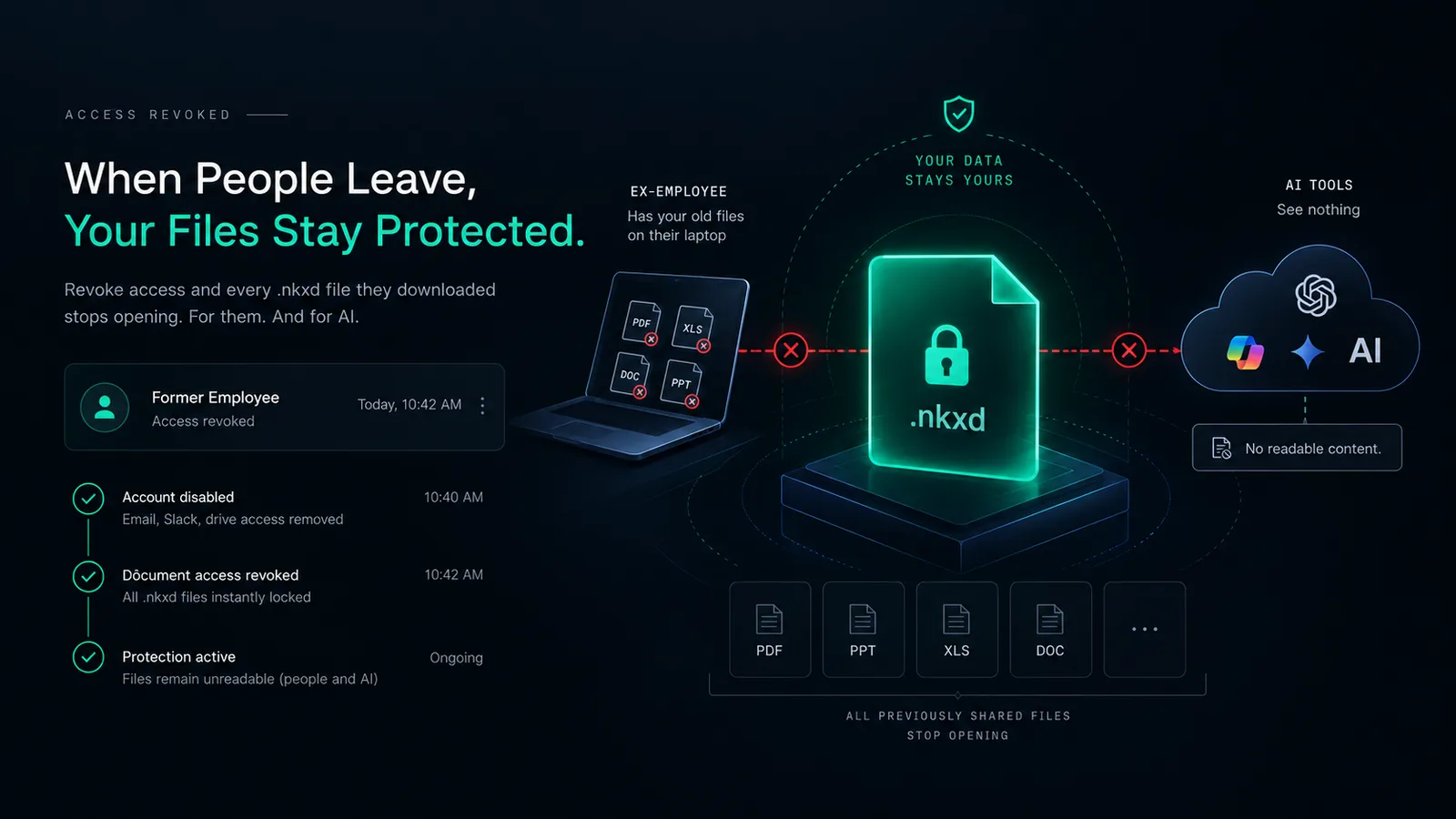
Let's peek under the hood and see how this actually functions. You know how AI environments constantly accumulate uncleaned data, old notebooks, experiment logs, you name it. NakodaX handles this with a feature called revocation.
Think of it as a master kill switch. When a vendor or ML team's access is pulled, the data remains structurally valid, so it doesn't break your pipelines, but it instantly becomes semantically empty. Section four, three pillars of control.
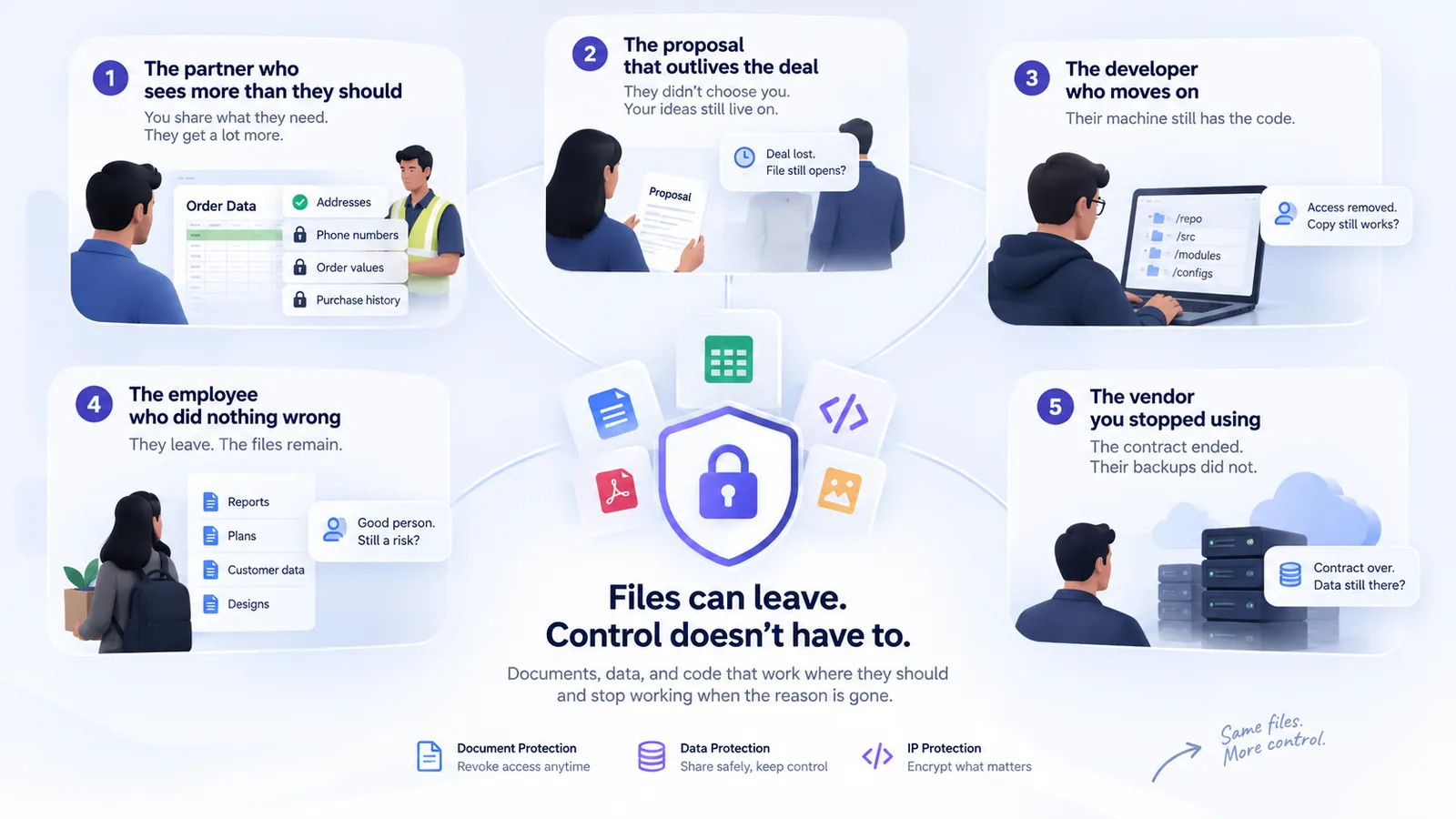
This is the vibrant core of the NakodaX ecosystem. NakodaX has built specific protections based on exactly what is leaving your system. We are looking at three visual pillars here.
Emerald green shields for document protection, cyan blue streams for data pipelines, and electric purple source channels for source protection. Let's detail those emerald green shields first. This is document protection.
Your files are actually encrypted right there in your browser. Whether you're using Drive, SharePoint, OneDrive, or Dropbox, you can share selected pages or rows, completely neutralizing the risk of unauthorized AI tools like ChatGPT ingesting their unencrypted files. Next up, the cyan blue streams for data pipelines.
This lets your data platform leads move only the data that's actually needed. You can filter rows, hide sensitive columns, and deliver strictly controlled expiring views directly to recipient warehouses like Snowflake or Databricks, all while enforcing retention and keeping technical control. Finally, we have the electric purple source channels for source protection.
This is absolutely crucial if you're deploying software. It allows you to protect your proprietary logic components per customer deployment. You don't hand over your IP.
Instead, you set hard end dates to automatically revoke access the second a contract wraps up. Section five, securing the AI boundary. So, how do teams actually implement this without killing their momentum?
It really boils down to a super clean four-step operational model. One, choose what leaves. Two, protect the sensitive parts.
Three, keep using your existing workflows. It integrates right into the file services and warehouses you already use. And four, keep control by checking permissions and enforcing strict time limits.
I absolutely love this highly practical advice from the source material. Start with one data set and one team. The goal isn't to boil the ocean and lock everything in a giant vault.
It's simply targeted security, making sure the sensitive parts cannot be read where they absolutely shouldn't be read. Which brings us to our final part, section six, protect before it leaves. This addresses the ultimate question of trust.
Here is the kicker. NakodaX never sees or stores your readable files. We aren't just talking about a legal contract that promises good behavior.
This is a hard technical control. Encrypted data moves directly between your systems and the destination without the vendor ever storing the readable content. Remember, your documents, your data pipelines, your source code, they are literally always just one accidental upload away from an AI tool.
Relying purely on a handshake isn't enough anymore. You absolutely must maintain strict technical boundaries to keep control within your business. So, the takeaway is simple.
Protect before it leaves. Think about it. Once your data crosses your production boundary, is it truly safe or is it already training someone else's model?
Head over to NakodaX.com to take your control back.