
NakodaX

Situations · IP protection

How to make an on-premise software trial actually expire

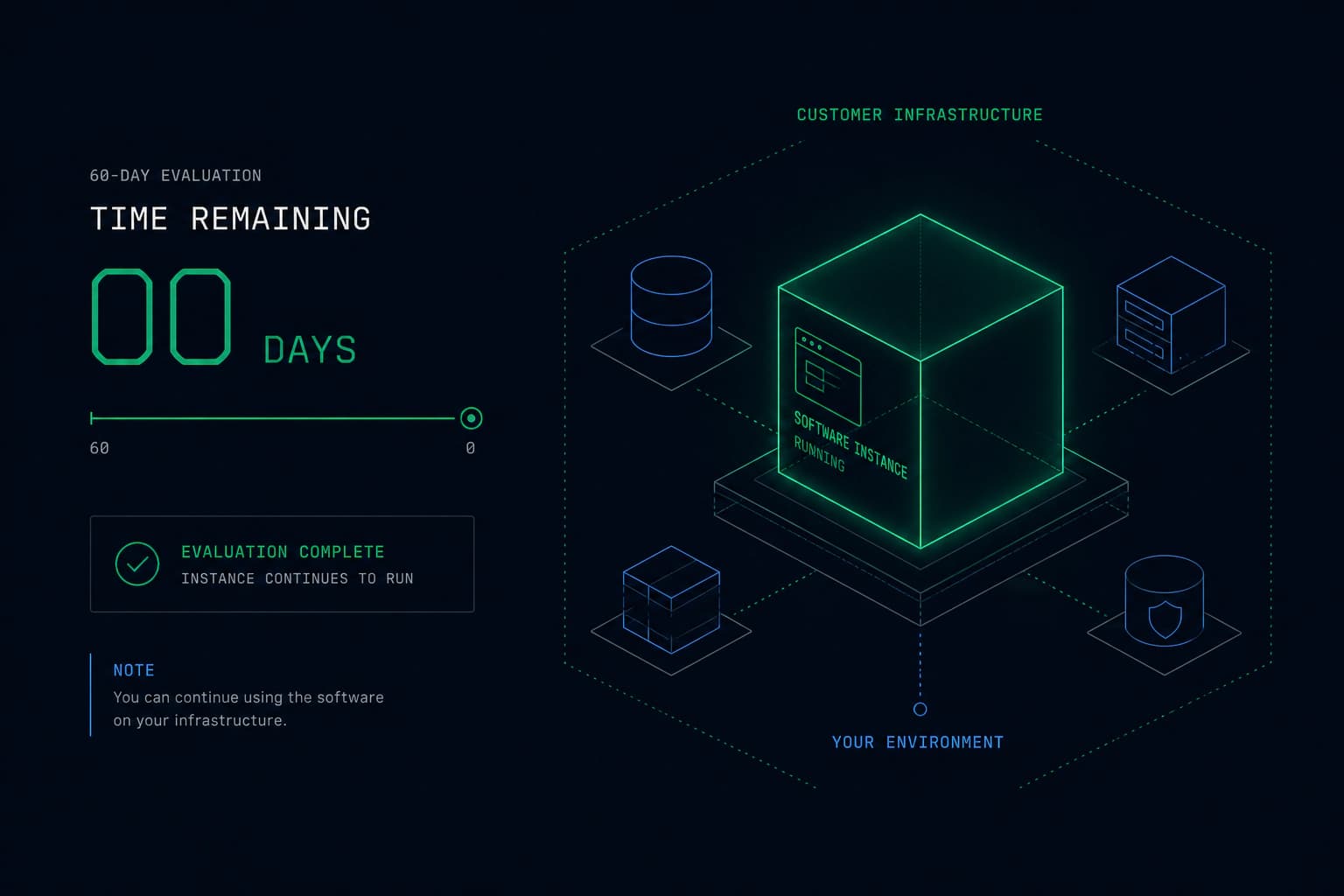
An expired evaluation deployment still running on a customer’s infrastructure.

On-premise pilots frequently outlive their evaluation period because ending them requires action from the customer, who has no incentive to act. If the protected parts of the software check for permission, the pilot expires on schedule by itself, turning a stalled evaluation back into a live buying conversation.

Why pilots do not end on their own

An on-premise evaluation ends when the customer takes an action: uninstalling, decommissioning the VM, telling their team to stop.

Look at the incentives on their side. Ending the pilot costs them effort and removes something their team has started relying on. Not ending it costs them nothing. There is no deadline in their calendar, no invoice, and nobody in their organisation whose job it is to switch off software that works.

The asymmetry is total. You need them to act, and they have no reason to.

The zombie install

So the sixty-day pilot passes day sixty. The champion who sponsored it changes role. Budget slips a quarter, then a year. Procurement never issues an order because nobody escalated it.

Meanwhile the deployment sits on their infrastructure doing real work. In the worst version it quietly becomes production, because a team started depending on it while the deal stalled, and now nobody wants to be the person who removes it.

You are supplying a customer who has never paid you, and your pipeline still shows the deal as open.

Chasing it makes things worse

The standard remedy is a sequence of increasingly awkward emails asking whether a decision has been made and noting that the evaluation period has passed.

Those emails damage the deal. They move the conversation from whether the product is worth buying to whether you are being difficult about a technicality, and they put your champion in the position of defending you internally over an administrative matter.

You are also asking for something you cannot verify. Whatever they reply, you still do not know what is running.

Day 31 as a sales event, not an email

When the protected parts of your software check for permission, the pilot expires by itself. Nobody at the customer has to act, and nobody at your company has to ask.

What happens next is the useful part. A stalled evaluation becomes a live conversation, opened by them, at the moment the product stops. Those are the best conditions you will ever get for a buying discussion, because the value has just been demonstrated by its absence.

Extending becomes a decision you make in a dashboard, which is a considerably better position than a chase email.

It changes what you can offer

The second-order effect is that you can be more generous with pilots rather than less.

Most vendors restrict evaluations precisely because they are hard to end: limited data volumes, limited users, limited features. A pilot that reliably stops on schedule can be a full-fidelity pilot, and those convert better.

What changes

The pilot has a switch. Day 31 arrives, the protected parts stop running, and the conversation about buying becomes a real one. No awkward emails, no chasing, no free product quietly in production.

access ended

Related questions

How do you make a software trial actually expire on-premise?
Ship the differentiating components so they require permission to run. When the evaluation period ends, permission is not renewed and those components stop working, without the customer needing to uninstall anything or your team needing to ask.
What do you do about a POC still running after the evaluation?
With a conventional deployment the only options are asking and escalating, neither of which is verifiable and both of which harm the deal. Preventing it requires the expiry to be built into the software before the pilot starts.
How do you enforce a pilot end date for enterprise software?
Make the end date a property of the software rather than an obligation on the customer. The pilot then ends on schedule by default, and extending it becomes a deliberate decision on your side rather than an oversight.

This one, or one very like it

IP protection. Start where the problem actually is.