
NakodaX videos/Data Protection·5:51
How to share business data securely
A partner needs some of your data, not your whole warehouse. See how Data Protection builds a controlled view for each recipient.
Questions this video answers
How do I share data with a partner without sharing my whole warehouse?
Can different partners receive different data?
Does NakodaX store my business data?
Transcript
Welcome to the explainer. Look, every single day, your business relies on sharing proprietary data with partners and vendors. I mean, it's just how collaboration happens, right?
But did you know that the exact moment a normal copy of your data leaves your system, your control over it usually vanishes entirely? Today, we're unpacking a brilliant solution to this massive headache. We are going to see exactly how NakodaX data pipelines solution protects your work before it ever even leaves your hands.
Okay, let's dive right into this. We all know this familiar dilemma. An external partner needs your data to do their job.
That's just a basic fact of doing business. But do they really need your whole data warehouse? Well, of course not.
Yet, far too often, businesses rely on messy exports or honestly just overly broad access permissions simply to get a project moving. It's a massive risk. We really need a way to share precisely what is needed and absolutely nothing more.
And this is exactly where NakodaX comes into play, acting as your central security hub. Think of it like a highly intelligent control layer sitting precisely between your internal data source and your external recipient. It's not just a dumb gate.
It's an active orchestrator. It bridges the gap, ensuring that the required data flows out to a partner while you maintain absolute total authority over that information. Choose protect control the data pipeline journey.
So, how does this actually work in practice? Well, it's a super clean, highly structured process. First you have your source warehouse on the left.
Then that data flows straight into the policy application stage where your rules are set. From there a highly specific controlled view is generated. And finally that controlled view travels safely to the recipient's destination system on the right.
The data flows in one direction getting transformed and secured along the way. Let's break down what happens at each of these critical steps. It all kicks off with choose.
Instead of creating these massive, highly vulnerable copies of your entire database just to hand off to a vendor. NakodaX data pipelines simply reads the required data directly from your large source warehouse. You're selecting only the exact rows and columns that are absolutely necessary for this specific partnership.
And the rest of your data, it stays completely untouched and out of sight. You are actively choosing what should leave your business. Now, what's really interesting about this next step is the protect phase.
Once NakodaX reads the data, you apply four core protection policies to create that controlled view. First, you can filter out specific rows so they're never even sent. Second, you can completely hide entire columns.
Third, if you have sensitive values, you know, things like financial figures or personal identifiers, you can just mask them. And fourth, for your absolute most critical information, you can encrypt selected fields. You are surgically securing the sensitive parts before delivery.
Let's imagine this in the real world. Say partner A only needs a small subset of data for their contract. So they receive filtered rows.
But partner B is doing entirely different work. They need to see the overall volume of the data, but absolutely not the identities of your customers. So they receive masked values instead.
It's the exact same source warehouse generating two entirely different, perfectly tailored controlled views. The rule is simple, but incredibly powerful, one view per recipient. What this gives your business, legal, and operations teams is incredible flexibility by applying unique rules to specific data sets.
You get this brilliant adaptable layer of control around your sensitive work. And the best part, your internal teams don't have to change the familiar ways they work and they don't have to change the destination systems they send data to. NakodaX just ensures every single vendor gets exactly what they need safely.
So, here is the absolute most crucial takeaway. Literally, if you only remember one thing today, make it this. NakodaX does not become a store for your business data.
This is so incredibly important to understand. We're talking about data pipelines here, not a storage tank. The readable content moves from your source warehouse, gets protected by the policies, and arrives at the destination system.
It never rests on NakodaX servers. NakodaX orchestrates the protection. It does not hoard your proprietary information.
Which brings us to the control phase of our journey. You see, protection isn't just a one and done event on day one. It happens throughout the entire life cycle of your business relationships.
On day one, access is granted. Fast forward to month six and automatic retention rules might be enforced to ensure data isn't lingering longer than necessary. And at year 1, when the contract is over, access ends cleanly.
You apply access, expiry, and retention rules to every single relationship, giving you continued business control long, long after the data is initially shared. And because NakodaX creates unique controlled views for every single recipient, managing those relationships is entirely isolated. Ending access for one partner doesn't affect anyone else.
If one vendor's project wraps up, you revoke their access seamlessly. Meanwhile, your other active partnerships just continue operating without a single hiccup. You maintain total granular control over every individual pipeline.
It all boils down to this incredibly empowering rule. move the data they need, keep the rest under your control. It really is that liberating. You no longer have to make that awful choice between collaborating effectively and keeping your proprietary data secure.
By applying the principles of choose, protect, and control, you can confidently share essential information, knowing for sure that your most sensitive assets remain firmly under your governance. Keep control wherever your work goes. I highly encourage you to head over to nakodax.com to start securing your data pipelines today.
Thanks for joining me on the explainer. But right before you go, I want you to ask yourself, if your business shares data every single day, how much of your proprietary intelligence is currently sitting in someone else's system completely outside of your control?
More videos
Data Protection · 1:19
What happens when your data leaves your systems
A contract cannot technically control a copy of your data once it has left your systems. See what NakodaX adds instead.
September 20, 2026
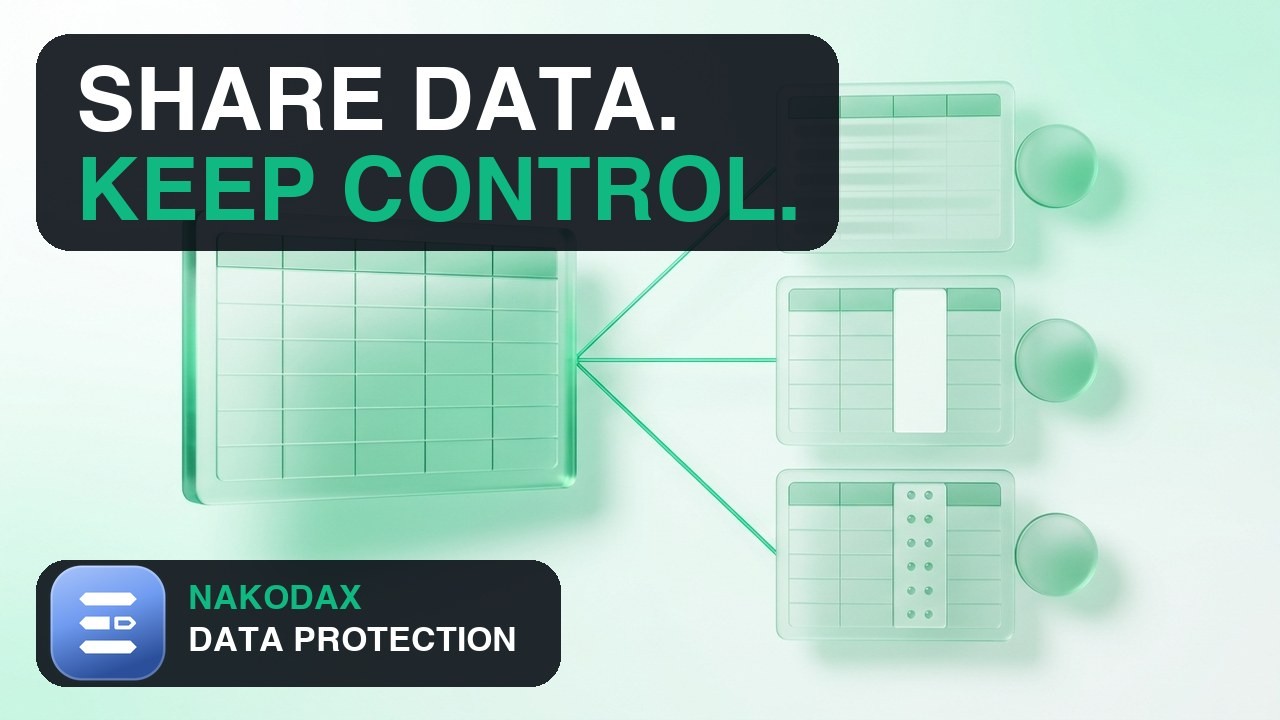
Data Protection · 1:44
Data Protection: Share Data Without Losing Control
NakodaX Data Protection lets you send data to partners from the pipeline you already run: each partner gets only their own rows and columns, sensitive columns are hidden or scrambled, and you can end access anytime.
October 15, 2026
Overview · 1:17
Protecting data beyond the security perimeter
AI tools, cloud apps and modern workflows have moved sensitive work past the traditional security perimeter. See how NakodaX follows it there.
September 21, 2026
From the blog

Data Protection · 2 min read
Clean room or Data Protection: when do you use each?
A clean room is for joint analysis. Data Protection is for the files that still have to leave. Here is how each works, and why many teams use both.
September 10, 2026

Data Protection · 2 min read
How do you share a customer table with a vendor safely?
A vendor needs your customer data to do the work, but not all of it. Here is how to give each vendor their own file and end access when the contract ends.
August 24, 2026
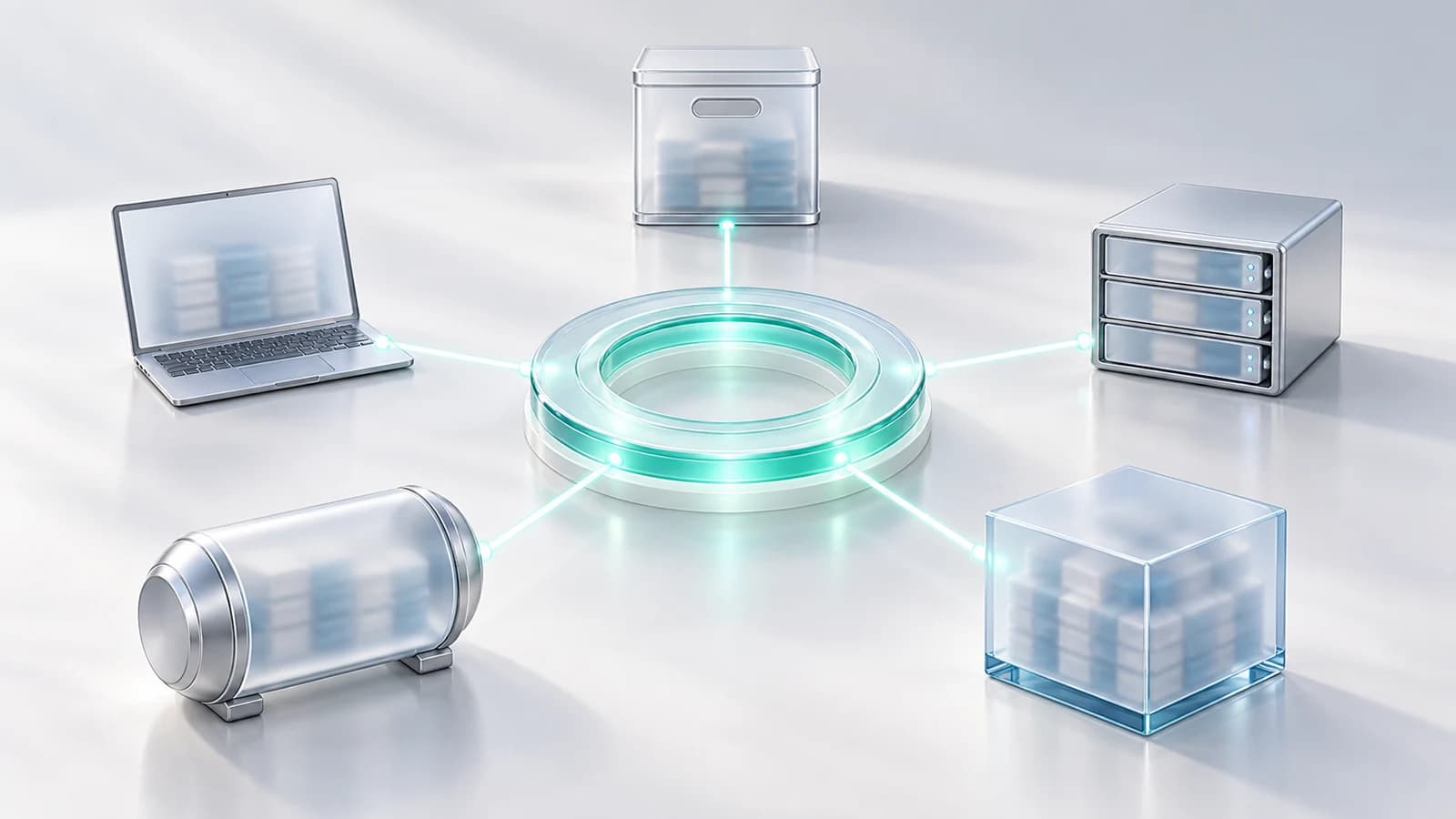
Data Protection · 3 min read
How do you control old copies of customer data?
Old exports, backups and vendor copies are hard to find and delete. Protect the data before it leaves, and every copy made after is covered.
August 29, 2026
Seen in practice
Real situations, and the video where there is one, on the same problem.
Situation
Drawings held by your manufacturer
Your contract manufacturer holds every drawing and spec you’ve ever sent. So does whoever they quote for next.
Read moreSituation
Customer records held by an outsourcing vendor
Your outsourced team processed customer records for six years. Where are those files now? Truthfully: you don’t know.
Read moreSituation
Customer lists sent to agencies for one campaign
Your data clean room covers the analysis. The customer list that went to three agencies and a measurement partner for one launch is still out there.
Read more