
NakodaX

Situations · Data protection

How to license data with an expiry that actually works

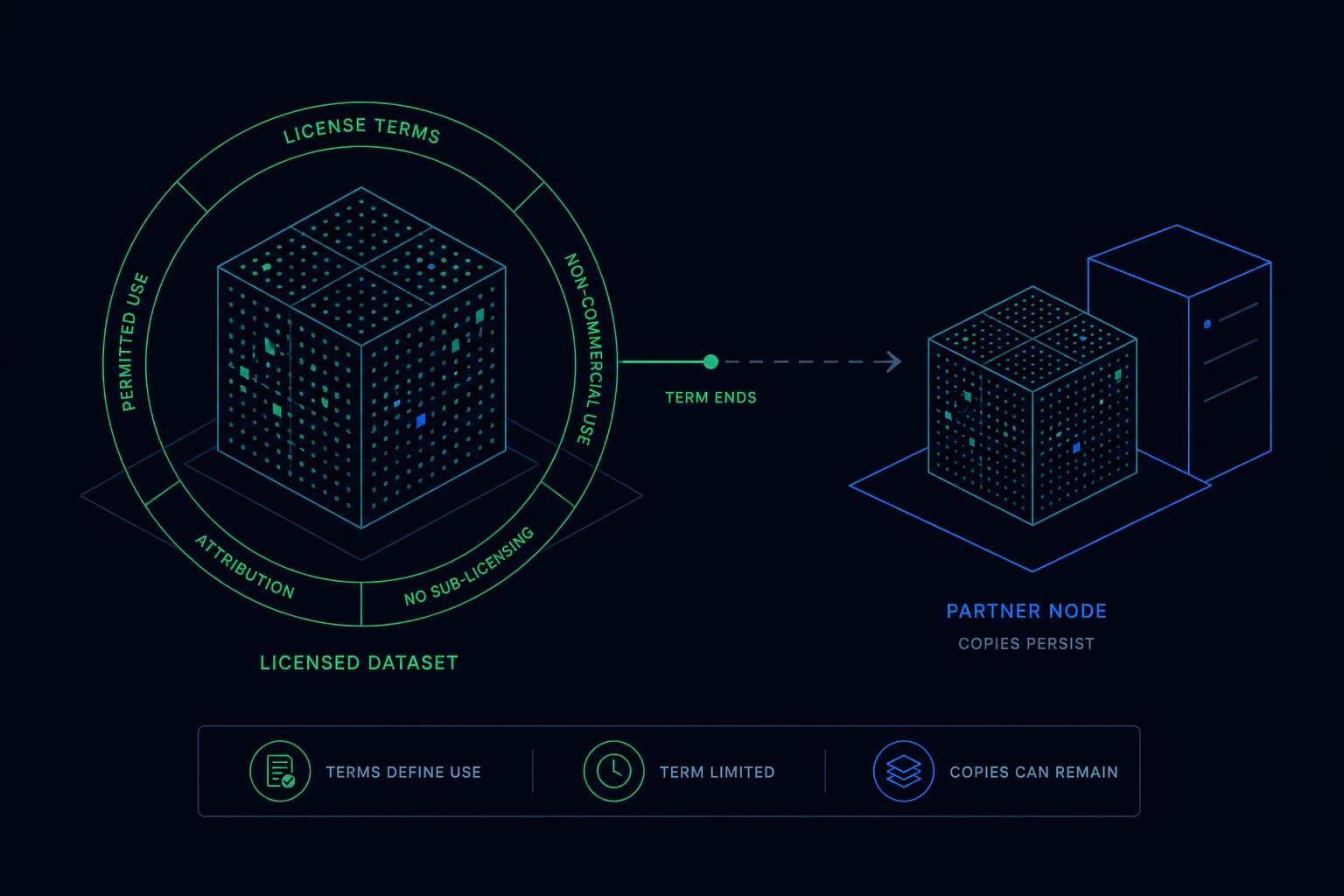
A licensed dataset still readable after the licence term has ended.

Data licences define a purpose and a term, but once a dataset is delivered as a file, expiry is enforced only by the licensee’s goodwill. Licensing data as permission-checked files makes the term real: the dataset is readable while the licence is active, every read is logged, and non-renewal has an automatic consequence.

Data became a product faster than the contracts caught up

Companies that collected data as a by-product of operating now sell it: transaction panels, location traces, pricing histories, industry benchmarks, anonymised behavioural sets.

Demand has risen sharply, and a large part of it is for training. Which sharpens every question about scope, because a dataset used to train a model does not stop being useful when the licence lapses.

Delivery undoes the licence

The agreement is careful. It defines the permitted purpose, the permitted users, the territory and the term. It has been through legal on both sides.

Then delivery happens, and delivery is a file. Once it lands, every one of those constraints is enforced by nothing except the licensee’s good manners and their fear of being audited by a supplier who has no way to audit them.

The term is the part that fails most obviously. It expires on a date, and the dataset does not notice.

Renewal with a consequence

This is the commercial heart of it. A data licence that cannot be enforced is a one-time sale dressed as a subscription.

Your renewal conversation is therefore a conversation about goodwill and about next year’s refresh, not about continued access, because continued access is not in question. The customer already has it.

When the dataset is readable only while the licence is live, non-renewal has an automatic result. That is not aggressive; it is simply the deal both parties signed, functioning.

You also learn how the data is used

Because each read is checked, each read is recorded. For a data business that is a new sense organ.

You learn which licensees query heavily and which barely touch it, which fields matter, and which parts of the set justify a premium tier. You can price by value rather than by volume, because for the first time you have evidence of value.

It also surfaces scope drift. A licence sold for one team that is being read at ten times the expected rate is a conversation worth having while the relationship is good.

What licensees usually ask

Two questions come up. Whether it slows their pipeline, and what happens if your service is unavailable.

Both deserve straight answers on a call rather than reassurance here, because the honest response depends on how they consume the data. It is worth saying plainly that a dataset which reads without checking anything is a dataset you have permanently given away.

What changes

The dataset is readable while the licence lives, and not a day longer. Renewal stops being a courtesy conversation, because non-renewal has a consequence. Every read is logged, so you also learn how the data is actually used. Data goes from a one-time sale you cannot take back to a subscription you can actually enforce.

access ended

Related questions

How do you license data with an expiry?
Deliver it as permission-checked files rather than as a plain transfer, with the permission set to end when the licence term does. The dataset is readable while the licence is active and stops being readable afterwards, without depending on the licensee to delete anything.
How do you enforce data licence terms?
Enforcement after delivery is impractical with a conventional file, since the licensee holds a complete working copy. Making access conditional turns the term, the permitted users and the renewal into things that operate automatically rather than obligations you would have to litigate.
How do you stop a partner using data after the licence ends?
Withdraw the permission the data requires to be read. Copies the licensee holds stop opening, and you retain a record of access ending and of any attempts since, which is also useful evidence if the relationship later turns adversarial.

This one, or one very like it

Data protection. Start where the problem actually is.