
By Aditi Jain
Director, NakodaX ·
NakodaX blog/Document Protection·4 min read
Selective share lets you send only the pages or slides someone should see. Paired with AI-proof .nkxd files, the rest of your document never leaves your hands.
By Aditi Jain
Director, NakodaX ·
Every competitor makes you protect a file. NakodaX lets you protect a part of a file.
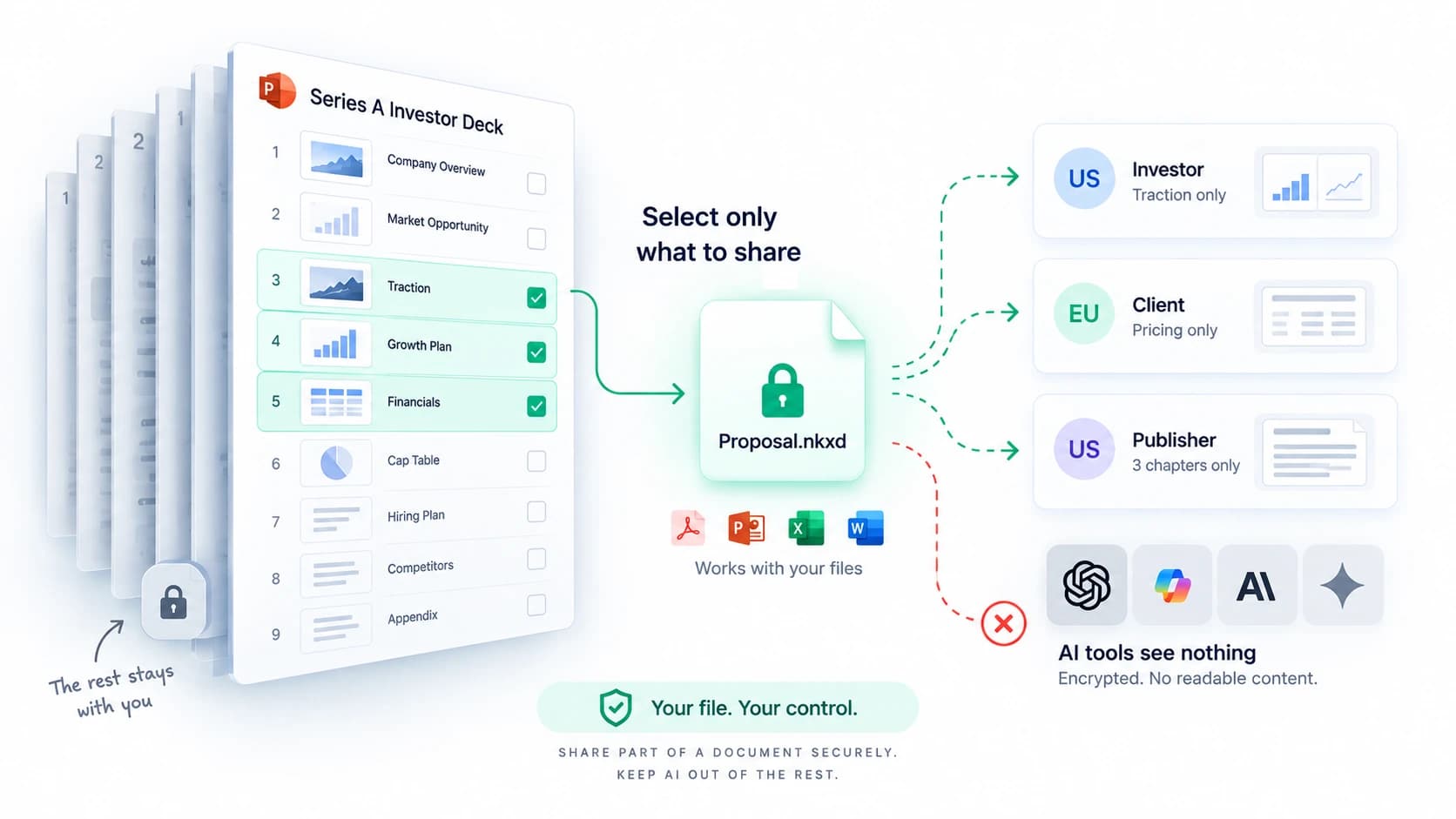
An investor asks for your traction numbers. You send the whole deck, because that is how decks work.
Now they have your cap table. Your burn. Your hiring plan. Your list of competitors and what you think of each one.
And because it is 2026, the first thing their associate does is upload the deck to AI and ask for a one page summary. Your entire company, condensed, sitting in someone's chat history.
You wanted to share three slides.
The slice you share arrives as a .nkxd file. It opens in a browser through NakodaX, with the access you set.
Drop it into ChatGPT, Copilot, or any AI tool and it returns nothing. The content is encrypted inside the container. There is no text for an AI to read.
So the investor sees three slides, on screen, with their name watermarked on each one. They cannot paste the slides into an AI. They cannot forward them to someone who can. And when the round closes or the conversation dies, you revoke, and the three slides stop opening too.
Unless you decide otherwise. If you want a recipient to be able to export and analyze what you sent, you can allow it. The point is that it is your call, not theirs.
The proof moment: share only the address page of your passport, only the salary rows of a bank statement, only the income line of a tax return. The person asking gets what they need to verify you, not a document they can run through AI to learn everything else about you.
The deal moment: one master proposal, a different slice per prospect. Each one sees their pricing, their scope, their terms. None of them can feed your proposal into AI to reverse engineer how you price everyone else.
The relationship end: partition one contract across every party. When the contract ends, revoke. There was never a full copy on their side to begin with, and there was never a readable one.
Send three slides, not the deck. Share the part they should see, keep the rest with you, and keep AI out of all of it unless you allow it.