
By NakodaX Marketing team
NakodaX ·
NakodaX blog/Perspective·4 min read
Documents, datasets, and source code protected by NakodaX stay unreadable to ChatGPT, Copilot, and every other AI tool, unless you authorize access.
By NakodaX Marketing team
NakodaX ·
Nothing pushed into an AI tool gets readable documents, datasets, or source code, unless you authorized it.
Every business shares work outside its own systems: documents, datasets, and source code.
Once a copy is readable, pushing it into an AI tool takes seconds. A recipient pastes a contract into ChatGPT, uploads a customer export to Copilot, or drops a code file into Gemini. Nothing about a readable file, table, or repository stops that.
NakodaX is built so there is nothing readable to push in, whichever kind of work it is.
A document, a data export, and a source file are all built to be read, by people, by software, by anything. That was the point of each format.
So when a recipient drops readable work into an AI tool, the tool reads it the same way it reads everything else. Nothing about the file, table, or repository says no.
Passwords, watermarks, and sharing links do not fix this. Whoever has the readable copy can still put it in front of an AI.
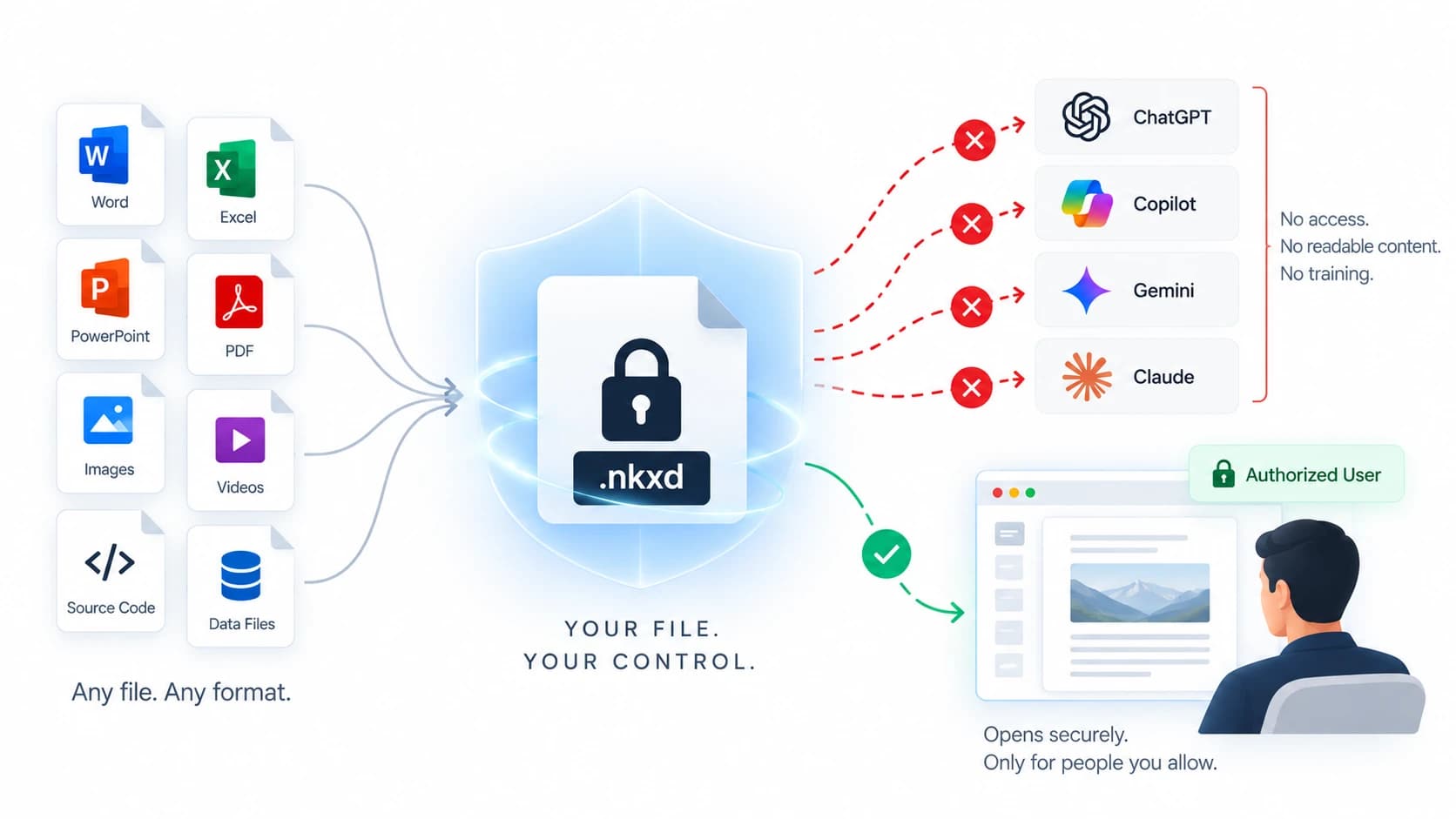
NakodaX turns a protected document, image, or file into a .nkxd container before it leaves you. The content inside is encrypted, and the key to open it stays with NakodaX under your control. The file itself carries no readable text, no readable cells, no readable slides.
Drop a .nkxd file into ChatGPT, Copilot, Gemini, or any AI tool, and it gets noise. There is nothing to summarize, extract, or train on.
Your recipient opens it in a browser, through NakodaX, with the access you gave them. That is the only door in.
Data Pipelines does not hand a recipient a file to protect in the first place. It reads from your warehouse and delivers each recipient a controlled view: selected rows, selected columns, masked or encrypted where the relationship requires it.
There is no complete readable export sitting in an inbox or a shared drive for an AI tool to ingest. A partner, a vendor, or a pipeline downstream only ever receives what that relationship was given.
Change the policy and every recipient's view changes with it, without hunting down old exports.
Source Protection keeps selected proprietary components out of the readable release that a vendor, developer, or customer receives. The software still runs normally in the environment it needs to run in.
The logic that makes the product valuable stays out of the files anyone could open, copy, or paste into an AI tool. AI can rename, restructure, or translate code it can read, but it cannot work with logic it was never given.
One customer's access can end without touching another's.
A screenshot can still go into AI. That is true of every protection product ever made, and anyone who tells you otherwise is selling something.
What NakodaX removes is the easy path. Copying a file, exporting a table, or pasting a function is one click. Recreating an entire document, dataset, or codebase by hand, screenshot by screenshot, is not. Most leaks happen because they are easy. Make them hard and most of them stop.
Protect the work before it leaves. Documents stay locked. Datasets stay filtered. Source stays out of the release. AI gets nothing readable to work with, unless you allow it.