
NakodaX

Situations · Data protection

How to enforce a data deletion clause

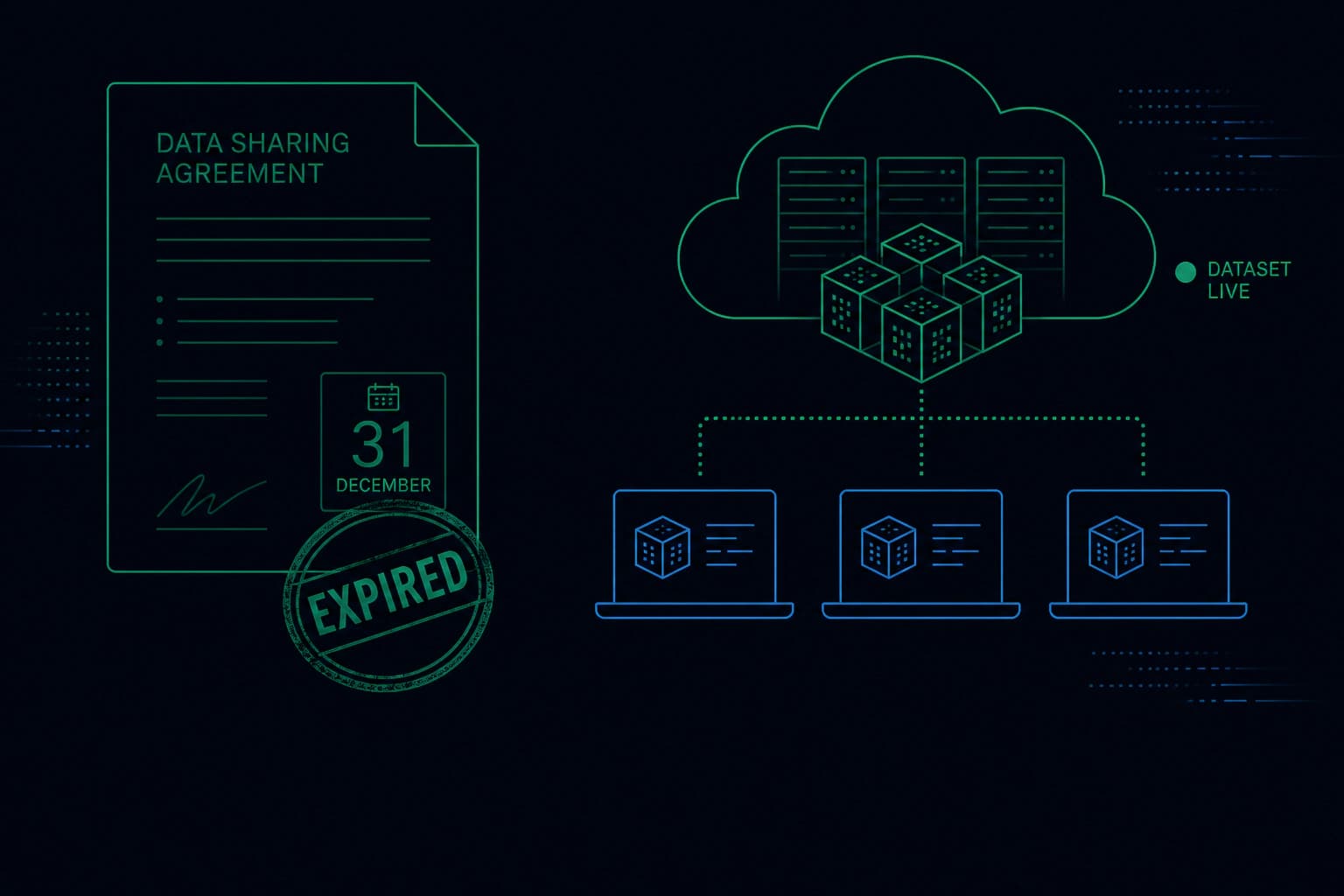
A data sharing agreement past its end date while the data stays readable.

In most contracts, data deletion at expiry is a clause enforced by a confirmation email that no one can verify. The verifiable version is sharing data as files that stop opening on the agreement’s end date automatically, with a log of when access ended and every attempted read since, which an auditor can inspect.

The first of January email

The agreement ended on the thirty-first of December. It might have been a research collaboration, a data sharing agreement, a pilot with a large partner, or a vendor arrangement that simply ran its term.

On the first working day of January somebody sends the email. Please confirm that all data provided under the agreement has been securely deleted. A few days later a reply arrives confirming it has, sometimes with a certificate attached.

That reply gets filed. In a regulated business it goes into an evidence folder that an auditor may one day read. And the uncomfortable truth, which everyone involved knows and nobody says, is that it establishes almost nothing.

Nobody has ever verified one of these

Consider what the person sending that confirmation actually knows.

They know somebody deleted the working copies they are aware of. They probably do not know what is in the backups, because backups are run by a different team on a retention schedule measured in years. They do not know what an analyst copied into a personal working folder in month three. They do not know what was exported for a quality review, or sampled into a training set, or attached to an internal email that is now itself backed up.

They are not lying. They are answering the only question they can answer, which is narrower than the question you asked.

And you have no way to check. You cannot inspect their storage. Audit rights, where they exist, are exercised roughly never, because exercising them against a partner you may work with again is a commercial act as much as a compliance one.

So the clause is real, the confirmation is filed, and the actual state of the data is unknown to both parties.

Make expiry a property of the file

The alternative is to stop relying on the other side taking an action at all.

When data is shared under ongoing permission, every read is checked against a rule you set. One of those rules is a date. Set it to the agreement’s end date, and access ends on schedule without anyone doing anything, without an email, and without the other party needing to remember.

The copies in their cloud storage do not need to be found. The copies on three laptops do not need to be located. The backup nobody has touched in a year does not need to be identified. None of them will open, because opening any of them requires a permission that has expired.

Deletion and revocation are not the same thing, and it is worth being precise: the bytes may still exist somewhere. What has ended is the ability to read them. For every practical purpose that matters to a regulator or a contract, that is the outcome the deletion clause was trying to buy.

What you can show an auditor

This is where it stops being a security feature and starts being a compliance one.

Because access is checked centrally, it is also recorded. You hold a dated record of when access ended, and a log of every attempt to open anything since. If nothing has been attempted, that is the record. If somebody at the partner tried to open a file in March, that is the record too, and it is a useful thing to know.

An auditor asking how you enforce data deletion at contract expiry currently receives a copy of an email. Instead they can receive a log showing the date access was withdrawn and every read attempt since. One of those is evidence. The other is correspondence.

Where this fits in an agreement

The clause itself does not need to change much. What changes is that it becomes describable in mechanical terms: data provided under this agreement is shared under access controls that expire on the termination date, and the provider holds the access record.

Partners are generally comfortable with this, often more comfortable than with a deletion obligation, because it removes an obligation they know they cannot fully discharge. Nobody enjoys signing a promise about their own backups.

What changes

The agreement’s end date is the data’s end date. Access expires on schedule, automatically, and you hold a record showing exactly when it took effect and every attempt to open anything since. “Deleted on termination” stops being a clause and becomes a log an auditor can read.

access ended

Related questions

What happens to shared data when a contract ends?
Usually it stays where it is. Deletion is a contractual obligation discharged by a confirmation email that neither party can verify, because it cannot account for backups, exports and working copies. Data shared under ongoing permission is different: access can expire on the termination date automatically.
How do you enforce a data deletion clause?
You cannot enforce deletion inside another company’s systems, and confirmations are unverifiable. The enforceable equivalent is making the data unreadable: share files that require permission on every read, set that permission to expire with the agreement, and keep the resulting access record.
What should happen at a data sharing agreement’s expiry?
Access should end on the date itself, without depending on the other party to act, and the ending should be recorded. A dated log of when access was withdrawn and every attempt to open anything since is evidence an auditor can inspect, which a deletion certificate is not.

This one, or one very like it

Data protection. Start where the problem actually is.