
NakodaX

Situations · Document protection

What happens to your bid after you lose the tender?

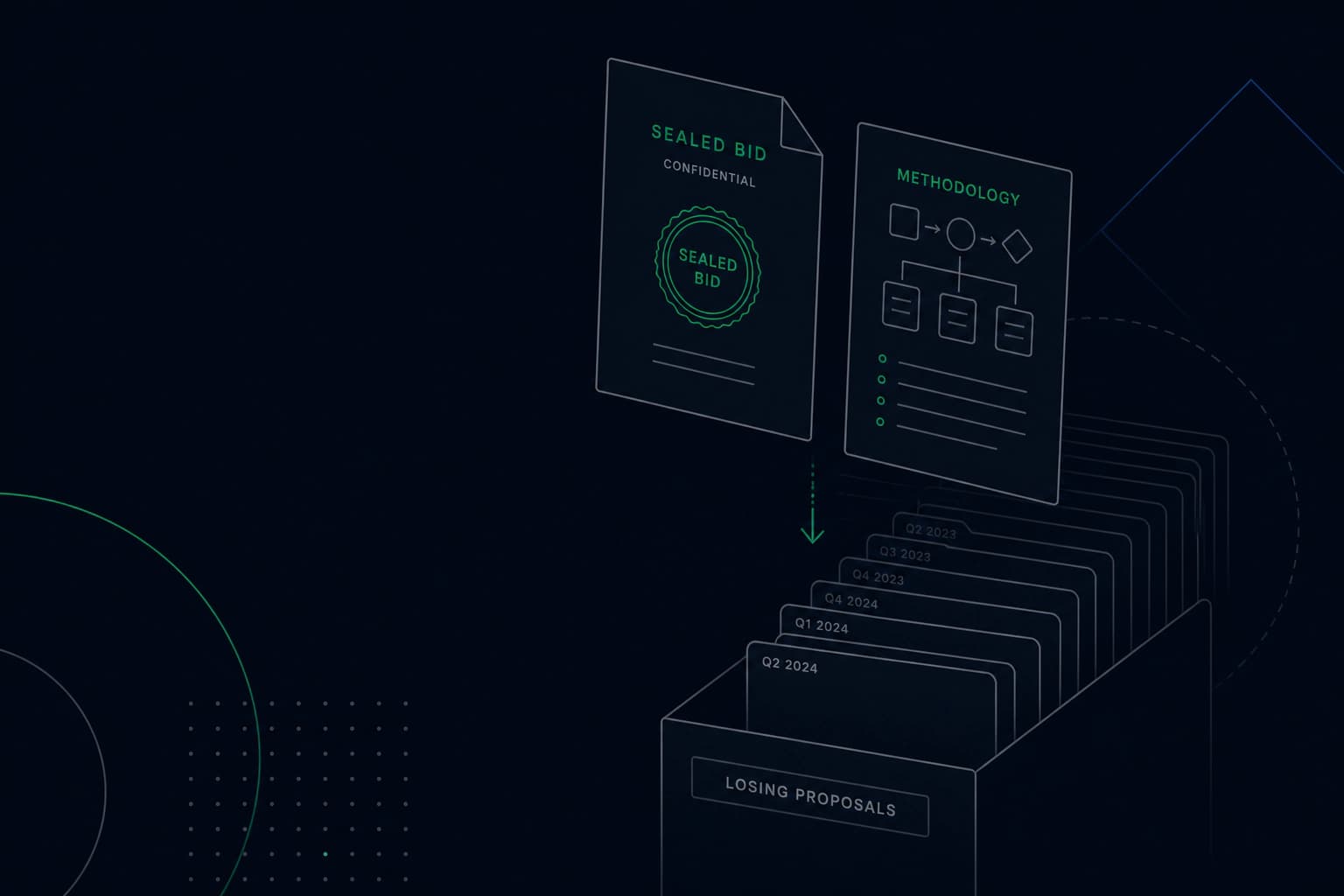
A submitted bid filed into a procurement archive alongside earlier proposals.

Losing bids are rarely destroyed. They are archived by procurement teams, reused as pricing benchmarks, and reread when similar projects arise. To limit this, submit bid documents as controlled links that expire when the award is announced, so pricing and methodology stop being readable after the decision.

An RFP asks for your best thinking in writing

A serious tender response is not a brochure. It contains your price, broken down further than you would ever volunteer. It contains your delivery methodology, which is the thing you actually sell. It contains named people with their real experience, your references, your assumptions, and your honest read on the risks in the project.

You assemble it over weeks, at real cost, and send it to an evaluation committee you have mostly never met, at an organisation that is simultaneously receiving the same depth of material from your competitors.

That is the arrangement, and it is not unreasonable. Buyers need comparable information to choose. The problem is not what you send. It is what happens to it afterwards.

Losing bids are archived, not destroyed

Procurement teams keep things. Often they are required to: public sector bodies have retention obligations measured in years, and private companies keep bid files for audit and for continuity when the person who ran the process leaves.

So your losing bid does not disappear. It goes into a folder, alongside every other losing bid, and it stays there.

It gets read again. When a similar project comes up in two years, the sensible first move for whoever inherits the file is to look at what was proposed last time. Your methodology, sitting in that folder, is a free consulting deliverable that keeps giving. Your price is a data point in a benchmark you never agreed to join, and it becomes the floor the next round is negotiated against, including rounds you are not invited to.

None of this requires anyone to act badly. It is what a competent procurement function does with the material it holds.

The specific cost of a permanent price

Of everything in a bid, pricing has the longest and most damaging afterlife.

A price you gave in 2024 for a particular scope, under particular commercial conditions, with a particular volume assumption, does not carry any of that context once it is a number in a spreadsheet. It becomes a fact about your company: this is what they charge.

It resurfaces when your costs have risen, when the scope is different, when the terms are worse. And it travels, because evaluation panels include external advisors and consultants who go on to advise other buyers.

Submit a bid that expires with the decision

The fix is to change what you submit, not what you write.

Send the bid documents as controlled links rather than attachments. The evaluation team opens them exactly as they would open anything else, with no account to create and nothing to install, which matters because friction in a tender process is not a risk worth taking.

Because each open asks your permission, you can attach a date. The natural one is the award announcement. Until then the panel reads freely, compares, shares internally with whoever is on the committee, and evaluates you properly. After the award, the documents stop opening.

Win, and you have a live contract and a relationship, and you can share what the delivery actually requires. Lose, and your pricing and methodology stop being readable on the day the decision is made, instead of remaining on file until the next cycle.

Does this cost you the tender?

It is a fair question, and worth being direct about, because a procurement process is exactly the wrong place to introduce friction.

The recipient experience is a link that opens. No sign-up, no software, no password. For most evaluations that is indistinguishable from an attachment.

Where a tender specifies a submission format, follow it. Some portals require a file upload and that is not a battle to pick. Plenty of tenders, particularly in the private sector, are conducted over email, and those are the ones where this applies cleanly. You can also apply it selectively: the commercial schedule protected, the qualification documents sent normally.

The other honest note is that a bid submitted this way says something about how you handle information, which is not a bad signal to send to a buyer who is about to trust you with their own.

What changes

The bid opens for the evaluation, and expires when the award is announced. Win or lose, your thinking stops circulating the day the decision is made.

access ended

Related questions

What happens to losing bids after a tender?
They are archived rather than destroyed, often under formal retention rules. Procurement teams reread them when similar projects arise and use previous pricing as a benchmark, so a losing bid’s methodology and price stay in circulation for years after the decision.
How can I protect an RFP response after submission?
Submit the documents as controlled links with an expiry tied to the award announcement. The evaluation panel reads them normally throughout the process, and once the decision is made the pricing and methodology stop being readable, so they cannot be archived as a future benchmark.
Do procurement teams keep old proposals?
Yes, routinely, and public sector buyers are frequently required to. Bid files are retained for audit, for continuity when staff change, and as reference material for future procurements of a similar shape.

This one, or one very like it

Document protection. Start where the problem actually is.