
By Pallav Boonlia
Founder & CTO, NakodaX ·

NakodaX blog/Perspective·5 min read
Network, device and cloud security protect where information lives. They do not decide what happens once a file, dataset or software release is shared outside your organisation. NakodaX adds that control for documents, data and source code: who can use it, what they see and when access ends.
By Pallav Boonlia
Founder & CTO, NakodaX ·

The future of security is not only about protecting where information lives. It is about protecting what happens when information moves.
On a Friday afternoon, a founder emails a confidential deck to an investor. The investor downloads it, forwards it to a colleague and saves a copy to a laptop. On Monday the founder changes their mind and removes access.
The link stops working. The downloaded copies may not.
Nothing in that story is a security failure. The network was fine, the account was safe and the sharing tool did what it promised. The problem is that the deck had already left the one place where anyone could still control it.
For decades, businesses have invested in protecting the places where information lives: networks, devices, applications and cloud infrastructure. That work matters, and it works.
But those controls mainly protect the environment. Some tools do add protection that follows a file, yet infrastructure security alone rarely keeps control once information crosses the boundary of your organisation. It enters systems you do not run, used by people you cannot see.
This is not a flaw in traditional security. It is a different problem, and it has been quietly waiting for a better answer.
The story repeats wherever business depends on someone outside your walls.
Documents. A contract, a financial model or a board pack goes to a client or an investor. Once it is downloaded, who opens it, how long they keep it and who they pass it to are no longer your decisions.
Business data. A partner needs last quarter's numbers for one region. What they receive is the whole export, because that was the easiest thing to send. Everything extra is exposure you chose without noticing.
Software. A company delivers its product to a customer. Inside that delivery sits the source code and logic that took years to build, and the customer now holds a copy.
The technical details are different in each case. The principle is the same: give people what they need without handing over more than you must.
There is one more reason this gap matters today. A document that once reached a handful of readers can now be pasted into an AI tool in seconds. Depending on the service and its settings, it may be stored, reviewed or used in ways the sender never intended.
As businesses connect more deeply and adopt AI, information reaches more people, systems and tools than any approval process can follow. Protecting the vault is no longer enough when the contents are constantly leaving it.
A stronger control layer rests on a few simple ideas.
Share only what is needed. Send the region, not the whole dataset, and the relevant pages, not the whole file.
Decide how it can be used. Who can open it, for how long and under what conditions.
Limit exposure by design. Assume the information will travel, and reduce what it gives away when it does.
Keep control over what comes next. Where the technology allows, end access when the deal ends, the contract expires or the relationship changes.
None of this is about locking information away. It is about making sure that when information leaves, it carries only what it should, and that you still have a say in what happens next.
We believe businesses need a control layer for information that must move. It should work alongside the infrastructure they already trust, not replace it.
That is what NakodaX is built to be. It focuses on the three things businesses share most often: documents, business data and proprietary software. Each is shared in a different way, so each needs controls designed for it: who can open a document and whether access can be ended, which part of a dataset a partner actually sees, and how source code is protected when software is delivered to a customer.
NakodaX starts from a simple belief: businesses should be able to share what is needed without giving away more control than necessary.
The future of security is not only about protecting where information lives. It is about protecting what happens when information moves.
Business will keep sharing. The only question is whether we do it deliberately.
Share only what is needed, decide how it can be used and keep a say in what comes next. Security that stops at your boundary is not enough for information that must move.
Start a free trial, or tell us what you share and with whom, and we will show you how NakodaX handles it.

New to NakodaX? Watch the overview
A full walkthrough of how NakodaX helps a business keep control of documents, business data and source code after they are shared, moved or deployed.
Watch the video (8:49)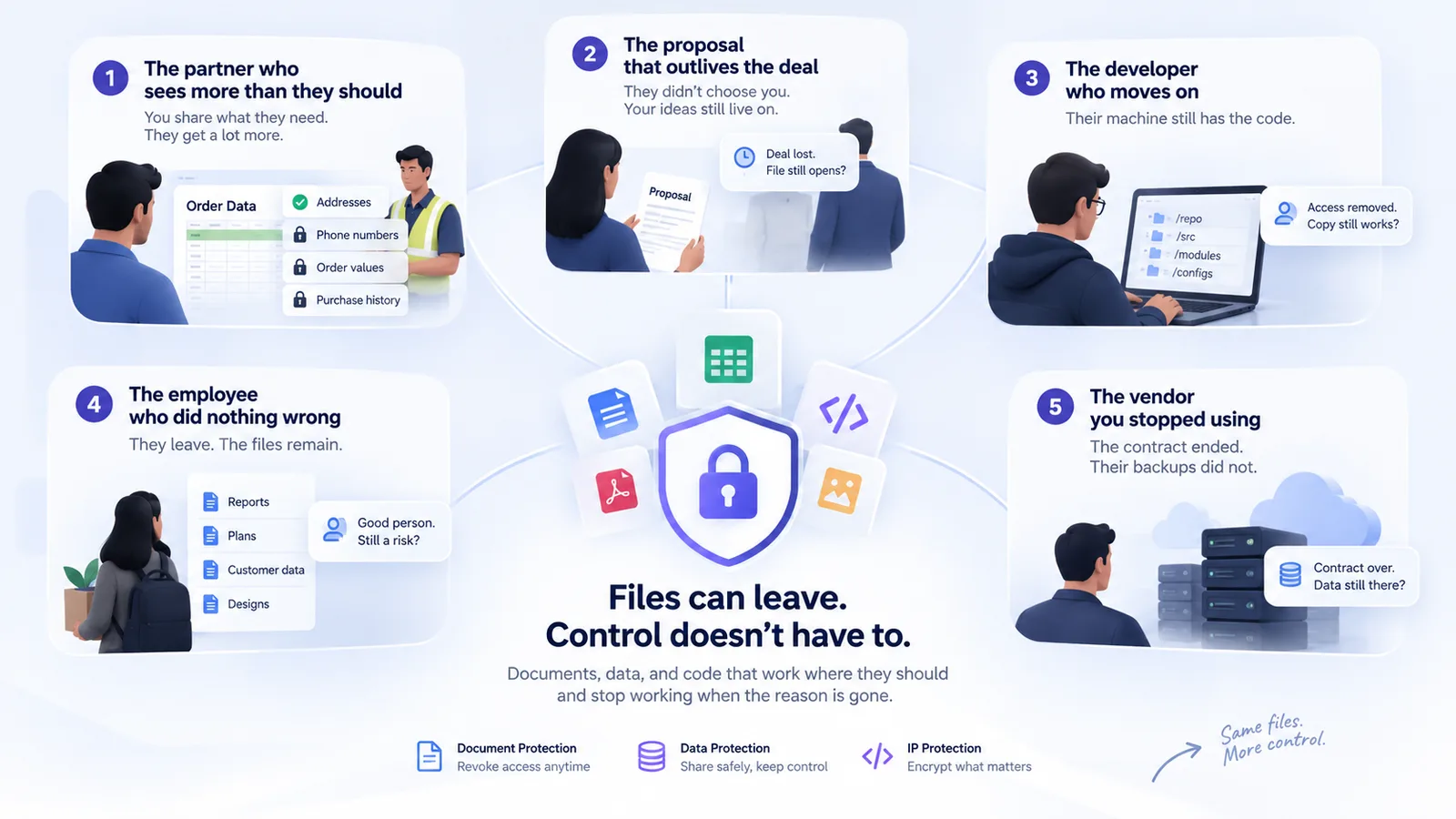
Perspective · 2 min read
Leaks are rarely about bad people. Here are five normal situations where a good team loses control of files, and what NakodaX changes in each.
September 13, 2026
Perspective · 3 min read
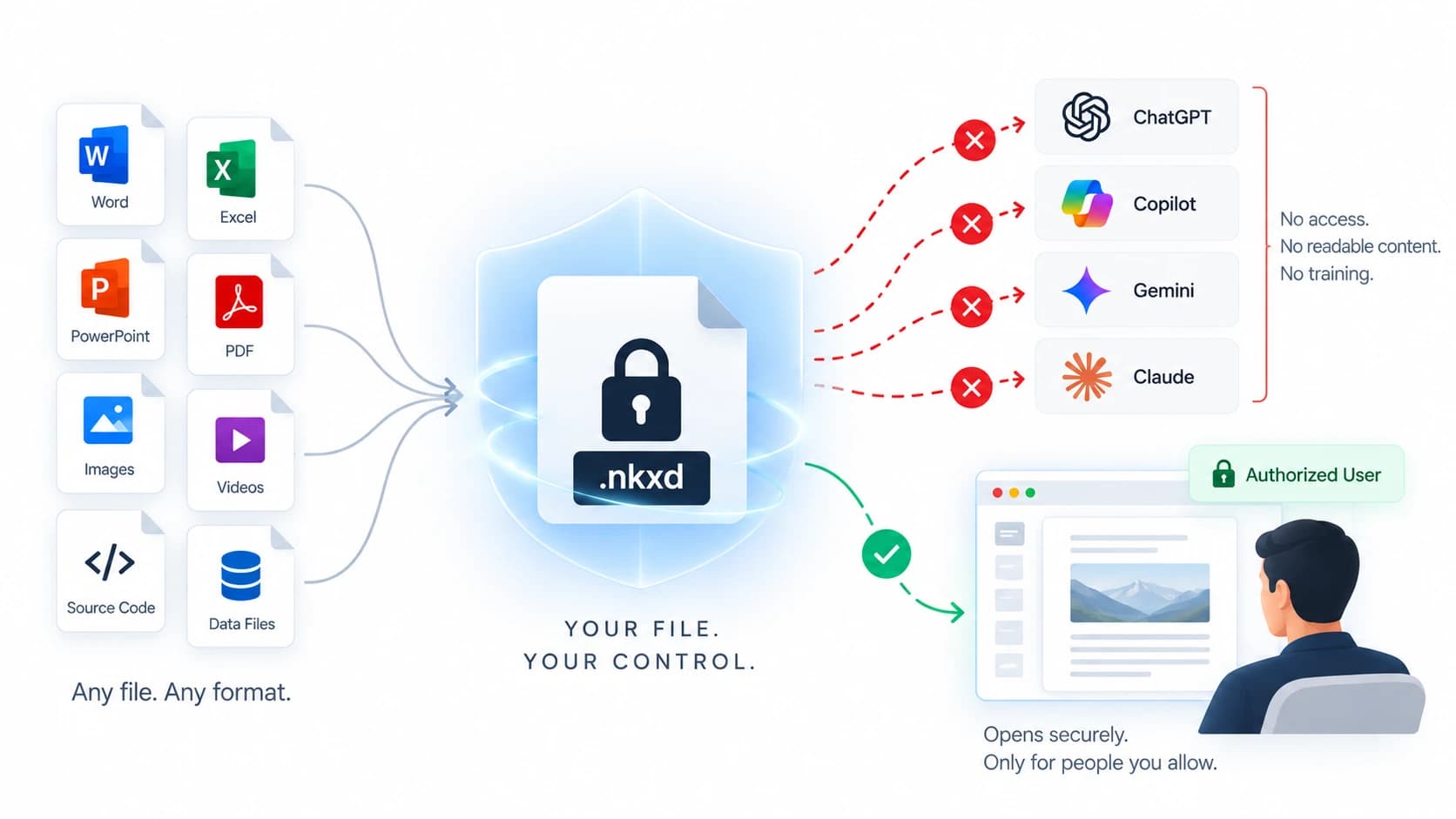
Protected documents, data files and code releases give ChatGPT or Copilot nothing readable. Here is how each works, and what a screenshot can still do.
September 4, 2026

Perspective · 2 min read
When a relationship ends, the files you shared do not end with it. Here is a checklist for documents, data and code.
October 11, 2026